Showing posts with label resources. Show all posts

Friday, November 05, 2010

All moms are homeschooling moms

I mean it.  I think we, as moms, might underestimate exactly how MUCH stuff we teach our children every day, whether they go to school or not.  Now that I am officially a home-schooling mom, I have started looking at our daily life in a whole new light.  And what do I see? 

Every. Single. Thing. is a learning opportunity.

We wake up, we read a book and cuddle.  Learning is going on here.
We cook breakfast and read a few poems.  Learning is going on here.
 We clean up.  Learning.
We go to the grocery store.  Learning.

You get the picture.  Now that I have accepted the responsibility of educating my kids, I realize that I've always had that responsibility, like all parents.  It's made me think more, though, made me look at every opportunity as a chance for discussion and explanation and experimentation.  I've gotten much better at narrating our day-to-day lives, something I am not naturally good at.   

It makes every day tasks more meaningful again, when I look at them in light of a new child-educating vocation. 

Inequalities with a hungry alligator 
(Another easy DIY project- just find an alligator clip art that you like, with a wide open mouth, and then make a copy of the image and reverse it.  Print a few, and glue them back to back, so that turning the card over makes the alligator face the other direction.  Alligator's mouth will eventually become the > and < mathematical symbols)

Wednesday, November 03, 2010

Math

This probably won't make sense as a blog post, but for posterity, I just thought I'd mention that I'll be using Miquon math and Singapore math for the first few years.  :-) 

Saturday, October 30, 2010

Rough Draft Science Curriculum: pre-k - 3rd/4th grade

This is actually more a list of rescources than a day-to-day curriculum.  I think that what is covered in a day or week or trimester will vary greatly, so I'll leave it open for now.

Also, I think I have an advantage because I LOVE math and science so much.  Many people are daunted by these subjects.  I, on the other hand, cannot WAIT to get into these materials and teach (and relearn) such fascinating stuff, from a new perspective (natural history).


Nature Study:

The Handbook of Nature Study
One Small Square series
Let's Read and Find Out series
Burgess Bird Book for Children
Various field guides for our region
Learning to identify plants (emphasized) and animals
Keeping a nature journal, as per Charlotte Mason's methods
Vocabulary of plant and animal parts, plant and animal life-cycles

Science:

Building Foundations of Scientific Understanding
Simple machines experiments, and any others that come up and are appropriate
Science in Ancient Greece
Archimedes and the Door of Science
 The Librarian who measured the Earth
Science in Ancient Rome
Galen and the Gateway to Medecine
Blood and Guts (maybe, I'm not thrilled with this one, but will use it as a place holder until I find a human body book or medical history book for kids that I like better)
The Body Book
Something on nutrition
Inventing the Future

I expect this general curriculum outline to be sufficient material for pre-k through 3rd-4th grade or so.

There is a lot of flexibility here.  Many of these books are to be read like stories.  Some of them have very involved projects and experiments.  Some are actual science "lessons" to be taught in a more traditional format.  Hopefully this will appeal to many learning styles and intelligences, until we figure out how Eliot and Ivy learn best.

Things that will NOT be in our curriculum:
Random and disconnected science experiments.  (Unless, of course, we are on our third straight week of rain or snow.)

Wednesday, October 13, 2010

Zoo Phonics: A review after 1 week

As I stated in my last post about learning to read, Eliot has been using 100 Easy Lessons for a bit over a month.  This is a fantastic book.  However, Eliot really is just a bit young for it, and as the pace picks up more and more, he hesitates more and more over remembering each sound. 

Since I had a huge bag of Zoo Phonics stuff just sitting on the counter waiting for me to take the time to look through (I had previously just ignored it when it arrived in the mail, since 100 Easy Lessons was going so well), I decided to just take a peek. 

It's hokey.  It's childish.  It's silly.  It's borderline ridiculous.  Which, of course, explains why Eliot took to it like a fish to water.  We have been using it for a week, and he knows all of the sounds, all of the animals, and all of the signals that go with them. 

Zoo Phonics, according to the website, is the only phonics system that integrates a kinesthetic element to the phonics learning system.  Each animal-letter hybrid has an alliterative name, reinforcing the letter's phonic value, and a body movement.  So, when I show Eliot the Olive Octopus card, he finds his matching card in his deck, waves his arms like an octopus, and says the short o sound.

Best of all, he thinks this is all gerat fun, and asks to play 2-4 times a day, a "game" that now takes about 10 mionutes, since he now has all of the alphabet cards.  That's 40 minutes of phonics in one day.  And he thinks it's just a fantastic animal game. 

We stuck the included poster on the front door out of desperation (couldn't get my scotch tape to stick to the walls) and now we practice as we are coming in and going out. 

I know this program is for young kids, because even Ivy can do about a half-dozen of the signals and sounds already. 

The result?  His 100 Easy Lessons are truly back to being easy lessons.  I actually really like the combination of these two programs, and I introduced Eliot to the zoo phonics alphabet cards in the order they were presented in 100 Easy Lessons, and not in the alphabetic order recommended by Zoo Phonics. 

What I like-
Very appropriate for pre-schoolers
Involves the child's auditory, visual, and physical skills, a must for a wiggly little boy. 

What I dislike
It can be expensive (they do offer a basic package for about $40 though)
I would have liked laminated cards or more durable cardstock
Not a lot of direction on where to go after your kid has mastered the basics.  Luckily, I know a pre-school teacher who is a pro Zoo phonics teacher.  :-) 
Nigel Nightowl himself

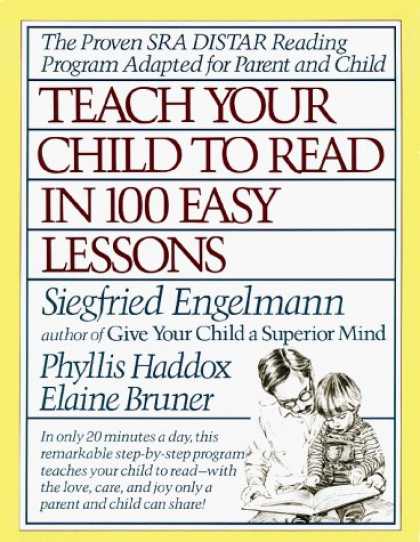
Teach your child to read in 100 easy lessons: Review after 33 lessons

Before anyone starts throwing rotten tomatoes, I just want to make my position clear:  It is very, very easy to determine the ideal age at which a child should learn to read.  It is the age where the child ASKS to be taught to read.  Forcing them to learn when they are not ready, or denying them knowledge they want both seem pretty silly.

Eliot asked to read about 6 months ago, and I have been gently putting him off for a while, while trying to find the "perfect" reading program for him.  Before that, I had to figure out if we were doing phonics or whole word, a hot-button issue for the new reading crowd.  After much debate, I went phonics. 

I ended up ordereing 2- The cheap and ugly Teach Your Child to Read in 100 Easy Lessons, and the beautiful ZooPhonics System.  I'll talk about zoo phonics in another post.

So here's how I ended up choosing 100 Easy Lessons over Zoophonics- it arrived in the mail first.  That may seem like a totally arbitary way to decide what program to use for teaching a life-changing skill like reading.  It seems that way because... it is, indeed a totally arbitarary way to choose.  :-)

However, I have to say, for the huge investment of 15 bucks, Eliot is now reading 3-4 full sentences per day, all by himself.  (He's on lesson 33, so 1/3 done.).  The book moves insanely fast, and yet, Eliot is doing just fine.  Sounds are introduced every other lesson, and similar sounds (b and d, for example) are spaced out far from each other, so as to be less confusing.  This is a great advantage in my mind over Zoophonics, which goes in alphabetic order (although teacher can modify this order, it's not fixed in stone)  The sounds also seem to be introduced in such a way that words and stories can be presented, even with only half a dozen letters being used, so the child is quickly able to read words and simple stories- very gratifying!

100 Easy Lessons uses a slightly stylized alphabet, so that long and short vowels can be differentiated, and blended sounds like th appear as a connected symbol rather than two seperate letters.

Somewhere later in the book, these specialized letters will be gradually replaced with the standard alphabet, and at the end of the book, the child is reading about a solid page of text, and is supposed to be reading at a 1st-2nd grade level. (!)

This program takes 100 days to complete, so a bit over three months.  2nd grade reading level in three months?  We'll see.  However, I shouldn't sound pessimistic, so far the book has been working perfectly.

Eliot gets a sticker on a home-made sticker chart for each lesson, and a special treat every ten lessons.  As a side-effect of his sticker chart, Eliot can now count to 30 with only one or two hesitations.  I am not looking forward to the days where we count, twice (one before the lesson and once after the new sticker) to 87, 88, 89...  But at that point, I'm sure he'll have his numbers figured out just by force of repitition.


What I like about this book-
Cheap
Very user-friendly (parent reads a script)
Similar sounding letters are taught at different times
Unique font to seperate long and short vowels while learning
Concise lessons (approx 15 minutes)

Downsides-
Eliot is absolutely at the utter low end for age appropriateness with this book.  He is just able to sit still for the whole lesson (still is overstating it), and we do not do the writing practice part, as he is definitely not there yet with fine motor skills.
The material starts slow, but really, really picks up speed as it goes along.
Because Eliot was starting to stumble on some sounds, we began using ZooPhonics concurrently (more in a later post).
I feel manic-depressive with this book.  We have one lesson where I think, "We're both frustrated, I'm throwing it in a drawer for six months."  Then the very next lesson, Eliot zooms throguh with no issues (usually he stumbles in the new concept lesson, and does perfectly in the review lesson)
This book is definitely not suitable for a child that does not do well with a structured sit-down style lesson.  Eliot does pretty well with this, so this has not been a problem for us.