Eliot asked to read about 6 months ago, and I have been gently putting him off for a while, while trying to find the "perfect" reading program for him. Before that, I had to figure out if we were doing phonics or whole word, a hot-button issue for the new reading crowd. After much debate, I went phonics.
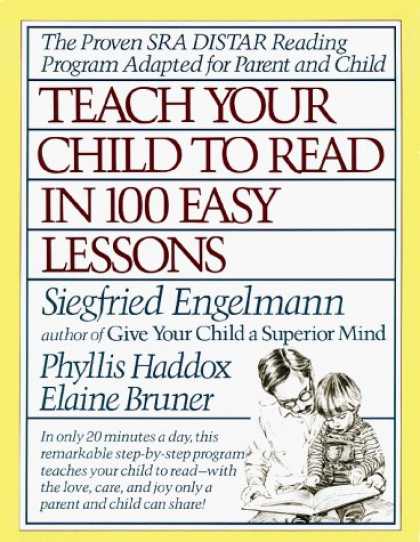
I ended up ordereing 2- The cheap and ugly Teach Your Child to Read in 100 Easy Lessons, and the beautiful ZooPhonics System. I'll talk about zoo phonics in another post.
So here's how I ended up choosing 100 Easy Lessons over Zoophonics- it arrived in the mail first. That may seem like a totally arbitary way to decide what program to use for teaching a life-changing skill like reading. It seems that way because... it is, indeed a totally arbitarary way to choose. :-)
However, I have to say, for the huge investment of 15 bucks, Eliot is now reading 3-4 full sentences per day, all by himself. (He's on lesson 33, so 1/3 done.). The book moves insanely fast, and yet, Eliot is doing just fine. Sounds are introduced every other lesson, and similar sounds (b and d, for example) are spaced out far from each other, so as to be less confusing. This is a great advantage in my mind over Zoophonics, which goes in alphabetic order (although teacher can modify this order, it's not fixed in stone) The sounds also seem to be introduced in such a way that words and stories can be presented, even with only half a dozen letters being used, so the child is quickly able to read words and simple stories- very gratifying!
100 Easy Lessons uses a slightly stylized alphabet, so that long and short vowels can be differentiated, and blended sounds like th appear as a connected symbol rather than two seperate letters.
Somewhere later in the book, these specialized letters will be gradually replaced with the standard alphabet, and at the end of the book, the child is reading about a solid page of text, and is supposed to be reading at a 1st-2nd grade level. (!)
This program takes 100 days to complete, so a bit over three months. 2nd grade reading level in three months? We'll see. However, I shouldn't sound pessimistic, so far the book has been working perfectly.
Eliot gets a sticker on a home-made sticker chart for each lesson, and a special treat every ten lessons. As a side-effect of his sticker chart, Eliot can now count to 30 with only one or two hesitations. I am not looking forward to the days where we count, twice (one before the lesson and once after the new sticker) to 87, 88, 89... But at that point, I'm sure he'll have his numbers figured out just by force of repitition.

What I like about this book-
Cheap
Very user-friendly (parent reads a script)
Similar sounding letters are taught at different times
Unique font to seperate long and short vowels while learning
Concise lessons (approx 15 minutes)
Downsides-
Eliot is absolutely at the utter low end for age appropriateness with this book. He is just able to sit still for the whole lesson (still is overstating it), and we do not do the writing practice part, as he is definitely not there yet with fine motor skills.
The material starts slow, but really, really picks up speed as it goes along.
Because Eliot was starting to stumble on some sounds, we began using ZooPhonics concurrently (more in a later post).
I feel manic-depressive with this book. We have one lesson where I think, "We're both frustrated, I'm throwing it in a drawer for six months." Then the very next lesson, Eliot zooms throguh with no issues (usually he stumbles in the new concept lesson, and does perfectly in the review lesson)
This book is definitely not suitable for a child that does not do well with a structured sit-down style lesson. Eliot does pretty well with this, so this has not been a problem for us.


1 comment:
Great review Monica! We just recently got to the part where they start using capital letters and taking off the long vowel symbols. After all that practice it was a pretty easy transition actually!
Post a Comment